
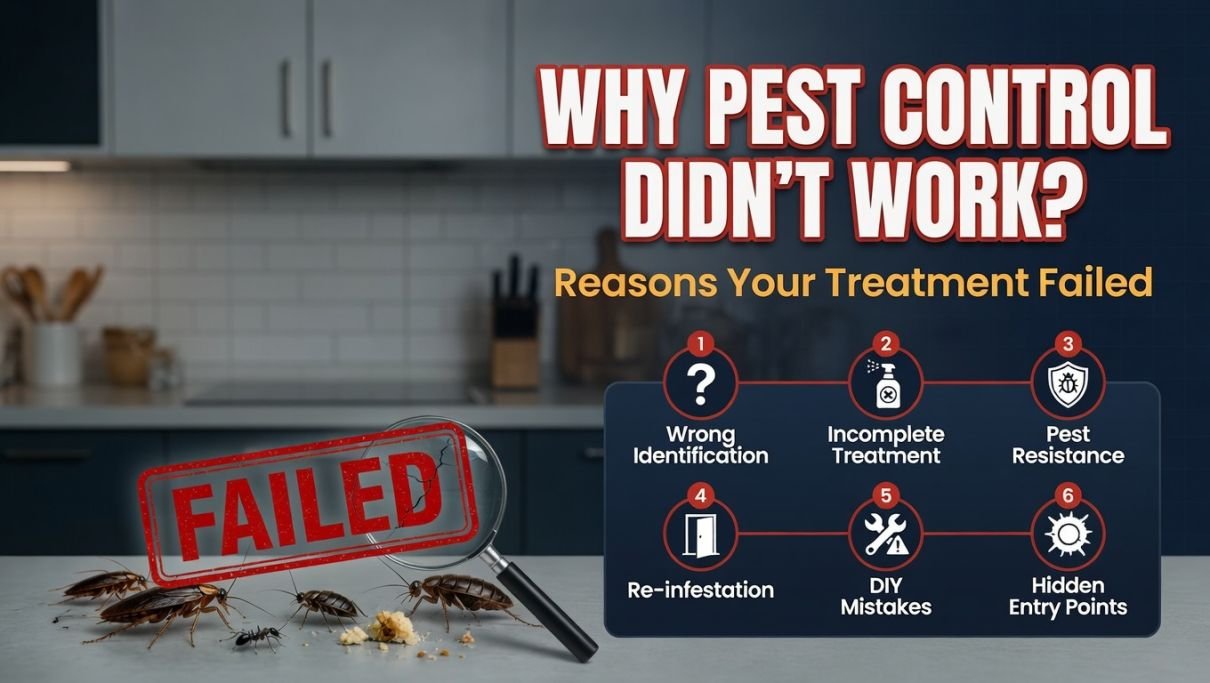
Even professional pest control treatments don’t always eliminate infestations immediately, and in some cases, they fail entirely. The challenge is knowing the difference between normal post-treatment activity and signs that the problem was never properly solved. Understanding how pest control actually works can help homeowners recognize what to expect, avoid common mistakes, and decide when additional action is necessary. Many homeowners assume that if pest control didn’t work, the treatment itself must have failed completely. In reality, pest control not working can happen for several different reasons, including hidden infestations, improper preparation, resistant pests, or environmental conditions that allow the problem to continue.
Pest Control Didn’t Work, How to Tell and What to Expect
One of the biggest misconceptions homeowners have is that pest problems disappear overnight. In reality, the timeline depends on the pest, the treatment method, and the severity of the infestation. There’s also a major difference between normal post-treatment activity and outright treatment failure.
A failed pest control treatment rarely looks dramatic at first. More often, it looks like a problem that never truly improves. The biggest warning sign is not seeing a clear downward trend in activity within the expected timeframe for that specific pest.
Some pests actually become more visible immediately after treatment because products disrupt nesting areas and force them out of hiding. Cockroaches may become more visible for several days. Ants may appear scattered before the colony collapses. Bed bugs may continue biting until eggs hatch and follow-up treatments are completed. That kind of short-term activity is often normal.
What is not normal is seeing the same number of pests every day long after treatment, fresh droppings or shed skins appearing regularly, new damage spreading to previously unaffected areas, live pests during daytime when they’re usually nocturnal, or bites continuing at the same frequency after bed bug or flea treatment.
Timeframes matter. Ant problems often improve within 2-7 days. Cockroach infestations may take one to two weeks before activity drops significantly. Spiders may require several days to a few weeks. Rodent problems may temporarily seem worse before exclusion work seals off entry points, but major improvement often takes one to three weeks. Fleas and bed bugs typically require multiple life cycles to fully eliminate because eggs survive initial treatments, and bed bug programs commonly take 30-60 days with multiple visits.
One of the clearest indicators of failure is when the infestation behaves exactly the same before and after treatment. Effective pest control changes the pattern of activity even before the pests are completely gone. When pest control didn’t work, homeowners usually notice that activity patterns remain almost identical for weeks after service, with no meaningful decline in sightings, droppings, bites, or new damage.
A quality pest control company should explain exactly what “normal” looks like after treatment, including what activity to expect, how long it may last, and when follow-up service becomes necessary. Companies that promise “instant elimination” for every pest are usually oversimplifying the problem.
Pest Control Company Mistakes That Make Treatments Fail
Most treatment failures are not caused by “bad chemicals.” They’re caused by poor inspection, rushed application, or using a one-size-fits-all approach.
Many failed treatments start long before the chemical is applied. One of the biggest mistakes pest control companies make is treating visible activity instead of identifying the conditions allowing the infestation to survive.
Some technicians rely on broad spray applications without locating nesting sites, moisture sources, hidden harborages, wall voids, breeding areas, or structural entry points. That approach may temporarily reduce activity while leaving the breeding population untouched. This is one of the most common reasons pest control fails, especially when technicians focus on surface activity instead of locating the source of the infestation.
Using the wrong product is another major problem. Different pests require entirely different strategies. Repellent sprays can actually push ants deeper into walls and split colonies into multiple nests. Certain bed bug populations have developed resistance to common insecticides, making outdated treatments ineffective. Over-the-counter fogging methods often drive pests into harder-to-reach areas rather than killing them.
Missed hiding areas are one of the most common causes of recurring infestations. Pests often survive behind appliances, inside appliance motors, under sinks, inside cabinet voids, attics, crawlspaces, pipe penetrations, electrical outlets, furniture seams, shared apartment walls, screw holes, and baseboards. Missing just a few harborages can allow the population to rebound quickly.
Application errors also matter more than most homeowners realize. Too little product may fail to establish a residual barrier. Too much can repel pests away from treated surfaces before they receive a lethal dose.
Another major failure point is skipping follow-up inspections. Many infestations, especially bed bugs, German cockroaches, fleas, and rodents, cannot realistically be eliminated in a single visit because pests hatch and reproduce in cycles. Without reassessment and monitoring, surviving populations simply rebuild. In many cases where homeowners believe pest control not working means the chemicals were ineffective, the real issue is that the treatment plan stopped before the infestation cycle was fully interrupted.
Failing to address exclusion is another common issue. You can eliminate pests repeatedly, but if cracks, vents, drains, or utility gaps remain open, reinfestation is inevitable.
The most effective pest control companies spend as much time inspecting and diagnosing as they do applying products. Inspection quality is often more important than the product itself.
What Homeowners Do Wrong Before and After Pest Control
Even excellent treatments can fail if preparation and follow-through are ignored.
Homeowners often unintentionally sabotage treatments by removing products, recreating favorable conditions, or disrupting the pest control strategy itself.
One of the biggest mistakes is cleaning too aggressively immediately after service. Mopping baseboards, scrubbing treated surfaces, wiping treatment areas, or deep-cleaning carpets and kitchens can remove residual products before pests have time to contact them.
Preparation failures are another major issue. Bed bug and flea treatments, in particular, depend heavily on proper preparation. Missing steps like laundering linens, reducing clutter, vacuuming properly, emptying cabinets, washing fabrics, or making furniture accessible can leave protected hiding spots untouched.
Food and moisture sources also keep infestations alive longer than expected. Leaving pet food out overnight, storing garbage improperly, ignoring plumbing leaks, allowing standing water, grease buildup, crumbs behind appliances, or bird feeders attracting rodents continuously supports pest survival even after treatment.
Some homeowners make the problem worse by mixing DIY products with professional applications. Store-bought sprays can interfere with bait systems, contaminate treated areas, scatter pests deeper into walls or neighboring rooms, and disrupt the treatment strategy itself.
Another overlooked issue is inconsistent follow-through. Pest control is often treated as a one-time event instead of an ongoing process. Missing follow-up visits, ignoring exclusion recommendations, failing to seal entry points, or leaving structural problems unresolved allows surviving pests to re-establish quickly.
In many homes, the infestation survives not because the treatment failed chemically, but because the environment still supports the pest. The most successful treatments happen when the homeowner and provider work as a coordinated team.
Why Some Infestations Are Harder to Eliminate
Not all pests behave the same way, and that dramatically changes how difficult they are to eliminate.
Some pests are relatively predictable. Ants follow established trails, many spiders remain near consistent harborages, and wasp nests are usually centralized and visible. These infestations can often be resolved quickly once the source is identified because the pests stay near food sources, travel predictable routes, and are more exposed to treatment.
Others are biologically built for survival.
Bed bugs are among the hardest household pests because they hide in extremely narrow spaces, feed briefly at night, reproduce rapidly, spread easily between rooms, and can survive for months without feeding. Unlike ants or spiders, they don’t consistently move through treated areas. Many remain hidden deep inside furniture, walls, outlets, mattresses, or personal belongings. A single surviving female can restart an infestation. This is one reason bed bugs coming back after treatment is such a common complaint, particularly when hidden harborages survive the initial service.
German cockroaches are similarly challenging because of their reproductive speed and ability to develop resistance to common pesticides. Their populations can rebound quickly if even small groups survive inside protected areas. Severe infestations are also where pest control fails most often when follow-up monitoring and sanitation corrections are ignored.
Fleas are difficult because treatment rarely kills every life stage at once. Adults may die quickly while eggs and pupae continue hatching for weeks afterward.
Rodents create different problems. Mice and rats adapt behaviorally, avoid unfamiliar objects, and exploit tiny entry points most homeowners never notice. Killing rodents without addressing those openings simply creates a cycle of reinfestation.
Termites are difficult because colonies may exist deep underground or inside structures, often remaining hidden while damage continues to spread.
Severity also changes success rates significantly. A small, localized infestation behaves very differently from one that has expanded through walls, furniture, insulation, or multiple rooms over several months. Long-established infestations usually require layered treatment strategies and ongoing monitoring.
The harder the pest is to expose consistently to treatment, the less likely a single visit will solve the problem completely. That’s why ethical pest control companies avoid guaranteeing “one-treatment elimination” for biologically difficult pests.
Bed Bugs Keep Coming Back After Treatment, Here’s Why
Bed bugs usually return for one of three reasons: survivors, eggs, or reintroduction.
The most common issue is incomplete exposure during the initial treatment. Bed bugs survive by remaining hidden in places people rarely inspect closely, including mattress seams, box springs, furniture joints, wall voids, behind outlet covers, picture frames, curtain folds, bed frames, baseboards, luggage, adjacent apartment walls, and even inside electronics. A treatment may kill exposed bugs while leaving hidden populations untouched.
Egg survival is another major factor. Many insecticides do not fully penetrate eggs, which means new bed bugs can emerge days or weeks later. That’s why professional bed bug elimination almost always requires multiple carefully timed visits around hatch cycles. Homeowners searching for answers about bed bugs coming back after treatment are often dealing with surviving eggs or hidden bugs that were never fully exposed during the original service.
Clutter dramatically increases survival rates. Piles of clothing, storage bins, books, and crowded furniture create thousands of protected hiding spots that are difficult to treat thoroughly. Even highly effective products struggle to reach bugs hidden inside stored items.
Apartment buildings create additional complications because bed bugs often migrate between units through shared walls, electrical conduits, plumbing penetrations, ceiling voids, and hallways. In these situations, a perfectly treated apartment can become reinfested from surrounding units.
Resistance to pesticides is another growing issue. Certain bed bug populations have developed resistance to common insecticides, which is why modern treatments often combine heat, steam, dust applications, encasements, monitoring traps, and targeted chemicals.
Reintroduction is also extremely common. Bed bugs travel easily through luggage, secondhand furniture, public transportation, hotels, rideshares, and shared laundry facilities. Many homeowners unknowingly bring them back after treatment ends. In some situations, bed bugs coming back after treatment may actually be a completely new introduction rather than survivors from the previous infestation.
One of the biggest mistakes homeowners make is assuming “no bites for a few days” means the infestation is gone. Bed bugs can remain hidden and reappear weeks later if monitoring stops too early.
Apartment Pest Control Not Working: The Multi-Unit Problem
Apartments create challenges that simply don’t exist in detached homes. Apartment pest control not working is extremely common in multi-unit buildings because pests rarely remain isolated to a single apartment for long.
In a standalone home, the infestation is usually contained within one structure and controlled by one household. In apartments, condos, and duplexes, pests move through an interconnected environment that no single resident fully controls.
Cockroaches, rodents, ants, and bed bugs commonly travel through shared walls, plumbing lines, electrical conduits, ceiling voids, heating systems, trash chutes, hallways, and utility penetrations. That means treatment in one unit may simply push pests into adjacent units temporarily before they return later. When apartment pest control not working becomes a recurring issue, untreated neighboring units are often part of the problem even if one resident follows every preparation guideline correctly.
For example, treating cockroaches in one apartment while neighboring units remain infested often shifts the problem rather than solving it. Bed bugs frequently spread floor-to-floor through wall voids, and rodents may nest in shared utility spaces inaccessible to tenants. In some buildings, the source unit may be several apartments away from where the activity is first noticed.
Apartments also create uneven sanitation and preparation conditions. One resident may fully cooperate while neighboring units maintain clutter, moisture issues, food debris, or untreated infestations. Another issue is limited access, since pest control companies often cannot inspect or treat surrounding units without management approval, leaving hidden reservoirs untreated.
That’s why large apartment infestations usually require building-wide inspection, coordinated treatment plans, management cooperation, and ongoing monitoring. In many cases, the success of treatment depends less on the individual unit and more on the condition of the surrounding units. This is why apartment pest control not working often requires cooperation between tenants, management, and pest control providers rather than isolated unit-by-unit treatment.
In large apartment buildings, pest control works less like isolated treatment and more like population management across an entire ecosystem.
Why Pest Control Fails: Environmental Factors
Environmental conditions often determine whether pests disappear temporarily or continue returning.
Humidity is one of the biggest drivers of persistent infestations. Damp environments support cockroaches, silverfish, termites, mosquitoes, and mold-feeding insects by creating stable moisture conditions they need to survive. Even the best treatment struggles if leaks, condensation, or poor ventilation remain unresolved. A leaking pipe inside a wall can effectively become a protected survival chamber where pests continue reproducing after treatment.
Seasonal changes also alter pest behavior. Ant colonies expand aggressively during warm seasons, rodents move indoors during colder weather, heavy rainfall may force insects into homes after outdoor nesting areas flood, and stink bugs and spiders often seek shelter in fall. Treatments sometimes appear to “fail” simply because seasonal pressure increases dramatically.
Structural vulnerabilities are another major factor. Small cracks, damaged weather stripping, roof gaps, dryer vents, crawlspace openings, utility penetrations, attic vents, foundation cracks, and damaged screens create continuous entry opportunities. Pest control treatments may reduce current populations while new pests enter through the same untreated openings. Without exclusion work, pest control becomes a repetitive cycle instead of a long-term solution. Many recurring infestations happen because pest control fails to address the environmental conditions that continuously support pest survival.
Neighboring infestations create constant pressure as well. Restaurants, dumpsters, vacant buildings, wooded areas, untreated apartments, and nearby homes can continuously introduce new pests into otherwise clean environments. This is especially important for rodents, bed bugs, German cockroaches, termites, and mosquitoes.
Some infestations persist not because the treatment failed directly, but because the environment keeps recreating ideal survival conditions faster than the treatment can eliminate them. The most effective pest control plans combine treatment with environmental correction, not just pesticide application.
Pest Control Not Working Still? How to Decide Your Next Step
Not every recurrence means the company failed. But recurring problems without clear progress are a warning sign. Persistent activity does not always mean pest control didn’t work, but it does mean the situation should be reassessed carefully before the infestation becomes more established.
A re-treatment is often normal when activity is decreasing gradually, egg cycles are still hatching, or the provider already explained that multiple visits would be necessary. This is common with bed bugs, fleas, termites, and severe cockroach infestations.
A different treatment method may be necessary when pests show signs of resistance or avoidance, or when environmental conditions weren’t addressed. Repeated chemical applications may fail if bed bugs are resistant to certain insecticides, rodents avoid bait stations, or ants continue splitting into secondary colonies.
In these situations, integrated methods such as heat treatment, steam, exclusion work, bait rotation, structural repairs, trapping, and sanitation correction may become necessary. For example, recurring bed bugs may require heat treatment, chronic rodent issues may require exclusion and trapping, and persistent roaches may require bait rotation and sanitation correction.
Changing providers becomes reasonable when there’s little evidence of strategy or investigation behind the service itself. Warning signs include no detailed inspection, technicians spending only a few minutes onsite, identical treatments regardless of pest type, lack of follow-up, poor communication, or no discussion of sanitation, moisture, or entry points.
A high-quality provider should be transparent about expected timelines, limitations, reinfestation risks, and what both parties must do for success. When pest control not working continues without any meaningful reduction in activity, homeowners should ask for a deeper inspection rather than repeated identical treatments.
The best companies don’t just spray, they diagnose. A strong pest control provider explains not only what they’re treating, but why the infestation exists in the first place.
What an Effective Pest Control Plan Looks Like
An effective pest control plan is never just “spray and leave.” It should function like a long-term management strategy rather than a single treatment appointment.
It starts with a thorough inspection. A technician should identify the pest species, infestation severity, nesting areas, entry points, moisture conditions, sanitation issues, and structural or environmental factors contributing to survival. Without that information, treatment becomes guesswork.
The treatment itself should be customized to both the pest and the property conditions. Effective plans often combine bait systems, targeted applications, crack-and-crevice treatments, dust applications, exclusion work, monitoring devices, sanitation recommendations, heat or steam treatment, and ongoing inspections.
For difficult infestations like bed bugs or German cockroaches, follow-up scheduling is essential from the beginning. Serious infestations almost always require reassessment, including re-inspections, monitoring, and retreatments if necessary.
Homeowners should also receive clear guidance explaining what activity to expect afterward, how long products remain active, what not to clean, and what conditions may cause reinfestation.
Guarantees should be realistic. Be cautious of “100% guaranteed permanent elimination” claims, especially for bed bugs, roaches, rodents, or apartment infestations. A reputable guarantee should clearly explain what’s covered, how long coverage lasts, what conditions void it, and whether follow-up visits are included.
The strongest pest control companies focus on reducing the conditions that allow pests to survive in the first place, because lasting pest control is rarely about chemicals alone.

